
Should Employers Conduct a Mid-Year HR Audit?
Direct Answer
Yes. Especially given recent PAGA reforms for California employers. A mid-year HR audit is no longer just an administrative safety check; it is a critical legal shield. Think of it as an extra layer of insurance. Under the reformed law, demonstrating that your organization took "all reasonable steps" to comply before a claim is filed can potentially cap your lawsuit penalty exposure at just 15%. June is the ultimate pivot point to secure that protection.
Think of it this way: most organizations conduct financial reviews throughout the year because waiting until December to discover a problem would be risky and expensive to fix
The same principle applies to HR.
By June, your organization has accumulated six months of unmonitored human choices: hiring decisions, payroll logs, and manager habits. When systems drift, severe financial and operational risk quickly follows. A mid-year HR audit creates an opportunity to pause, evaluate, and ensure that people’s practices remain aligned with legal requirements and organizational goals before entering the second half of the year.
The best time to fix an issue is before someone files a complaint, not after.
Why Does a Mid-Year HR Audit Matter?
Many organizations mistakenly assume that if there haven't been complaints, investigations, or lawsuits, everything is working as intended.
Unfortunately, that's not always true.
Some of the most significant HR risks develop quietly over time.
Documentation practices become inconsistent.
Managers begin applying policies differently.
Hiring processes evolve without oversight.
Leave requests are handled informally.
Performance conversations go undocumented.
None of these issues may seem urgent in the moment, but collectively, they create exposure.
Over time, concerns surface through an employee complaint, regulatory inquiry, or legal claim, and the underlying problem may have existed for months or even years.
A mid-year audit helps employers identify those vulnerabilities early.
It allows leadership to move from reactive problem-solving to proactive risk management.
More importantly, it creates an opportunity to strengthen employee trust.
Employees notice when organizations are intentional about consistency, fairness, and accountability.
That intentionality contributes directly to culture.
What Employers Need to Know
A mid-year HR audit should go beyond reviewing paperwork.
The goal is not simply checking boxes; it is to understand whether your HR systems are functioning effectively.
At People415, we encourage organizations to evaluate four key areas:
1. Documentation Practices
Documentation remains one of the most overlooked risk management tools available to employers.
Strong documentation supports:
Performance management
Employee relations decisions
Investigations
Corrective actions
Terminations
Leave administration
During a mid-year review, organizations should ask:
Are managers documenting consistently?
Are performance concerns addressed promptly?
Are corrective actions recorded appropriately?
Are employee files complete and organized?
If documentation varies significantly across departments or managers, it may indicate a broader leadership issue.
Consistency matters.
2. Policies and Procedures
Employee handbooks and workplace policies should reflect how the organization operates today.
Unfortunately, many employers update policies only when legally required.
As organizations grow and evolve, practices often change faster than policies.
This inconsistency creates risk.
Review:
Employee handbooks
Remote work policies
Leave procedures
Attendance expectations
Complaint reporting processes
Workplace conduct standards
The question isn't simply whether policies exist.
The question is whether they are current, practical, and consistently followed. Additionally, policies should align with one another to ensure consistency and avoid conflicting provisions.
3. Leadership and Manager Practices
One of the most common sources of HR risk isn't policy.
It's an inconsistency.
Managers often have tremendous influence over:
Employee experience
Documentation quality
Workplace culture
Compliance execution
A strong policy implemented inconsistently becomes a weak policy.
Mid-year audits should evaluate:
Meal and rest break practices
Performance management systems
Documentation habits
Accommodation processes
Leave administration
Communication consistency
Employees are more likely to perceive workplace decisions as fair when expectations are applied consistently across teams.
4. Employee Relations and Culture Indicators
Data often reveals problems before complaints do.
Organizations should review:
Turnover trends
Exit interview themes
Employee relations concerns
Workplace investigations
Engagement survey results
Retention patterns
These indicators provide valuable insight into organizational health.
For example, if one department experiences significantly higher turnover than others, leadership should investigate why.
The issue may not be compensation.
It may be management.
Culture leaves clues.
A mid-year audit helps identify them.
Common Mistakes Employers Make
Assuming No Complaints = No Risk
This is one of the most dangerous assumptions leaders can make.
Employees do not always report concerns immediately.
Sometimes they:
Stay silent
Seek employment elsewhere
Document issues independently
Wait until the situation escalates
A lack of complaints does not necessarily indicate a healthy workplace.
It may indicate a lack of trust.
Treating Audits as Compliance Exercises
Some organizations view HR audits as legal requirements.
While compliance matters, audits should also evaluate:
Leadership effectiveness
Employee experience
Operational consistency
Workplace culture
The strongest audits examine both risk and opportunity.
Waiting Until Year-End
December is often too late.
If a problem emerges in June and remains unaddressed until year-end, organizations lose valuable time.
Mid-year reviews create opportunities for corrective action before issues become entrenched.
Ignoring Manager Inconsistency
Two managers can follow the same policy very differently.
Employees notice.
And inconsistency is often at the heart of employee relations concerns.
Strong organizations audit leadership behaviors, not just written policies.
Legal and Compliance Considerations
A mid-year audit should include a review of compliance obligations under key employment laws, including:
Fair Labor Standards Act (FLSA), California Labor Code, and the Industrial Welfare Commission (IWC) Wage Orders
Review:
Exempt classifications
Overtime practices
Timekeeping procedures
Payroll consistency
Family and Medical Leave Act (FMLA) and California Family RIghts Act (CFRA)
Evaluation:
Leave tracking
Documentation procedures
Manager understanding
Communication practices
Americans with Disabilities Act (ADA)
Review:
Accommodation processes
Interactive discussions
Documentation practices
Consistency of implementation
Title VII of the Civil Rights Act
Assess:
Complaint procedures
Investigation practices
Anti-retaliation measures
Equal employment opportunity standards
Organizations operating in multiple states should also review state and local requirements that may exceed federal standards.
California’s PAGA Reforms
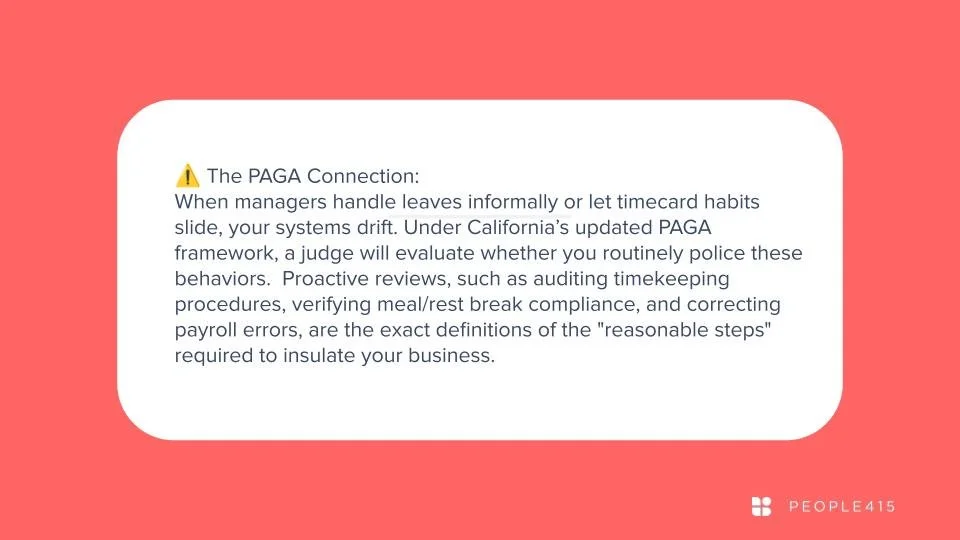
While all employers benefit from periodic compliance reviews, California employers face unique risks and opportunities under the state's Private Attorneys General Act (PAGA), which allows employees to pursue civil penalties on their own behalf, on behalf of other employees, and on behalf of the State of California for certain Labor Code violations. California's 2024 PAGA reforms created incentives for employers to take proactive compliance measures. Under the reforms, employers that can demonstrate they took "all reasonable steps" to comply with the law before receiving a PAGA notice may qualify for reduced penalties, potentially capped at 15% of the amount otherwise recoverable.
Examples of reasonable steps may include:
Conducting periodic payroll and wage-and-hour audits
Reviewing exempt classifications and overtime practices
Auditing timekeeping procedures and meal/rest break compliance
Updating policies and employee handbooks to reflect current legal requirements
Training managers and supervisors on wage-and-hour obligations
Promptly correcting identified issues and paying any amounts owed
While no audit can eliminate all risk, a mid-year review can help identify concerns early and demonstrate a good-faith commitment to compliance.
When Should Employers Get Help?
Organizations should consider outside support when:
Rapid growth has occurred.
Multiple states are involved.
Policies have not been reviewed recently.
Turnover is increasing.
Documentation practices vary significantly.
Employee relations issues are becoming more frequent.
Recent complaints have surfaced.
Leadership teams feel uncertain about compliance obligations.
An outside perspective often identifies blind spots that internal teams may overlook.
Expert Insight
At People415, we view HR audits differently from many organizations.
We don't see them as compliance exercises.
We see them as leadership tools.
The strongest organizations are not necessarily the ones with the most policies.
They are the ones with the most alignment.
Alignment between:
Policies and practices
Leadership and employees
Compliance and culture
Expectations and execution
A mid-year HR audit provides leaders with an opportunity to evaluate whether that alignment still exists.
Because when systems drift, risk follows.
Final Thought
The purpose of a mid-year HR audit isn't to find fault.
It's to create clarity.
By June, organizations have already established patterns that will influence the remainder of the year.
The question is whether those patterns are supporting organizational success or quietly creating risk.
The strongest employers don't wait for complaints, investigations, or lawsuits to reveal weaknesses.
They review systems proactively, strengthen leadership consistency, and adjust before problems emerge.
At People415, we help organizations build compliant, people-centered workplaces where policies, leadership, and culture work together.
Because prevention is always easier and less expensive than remediation.
And the best time to identify risk is before someone else does.
Sources
U.S. Department of Labor (DOL)
Equal Employment Opportunity Commission (EEOC)
Fair Labor Standards Act (FLSA)
Family and Medical Leave Act (FMLA)
Americans with Disabilities Act (ADA)
Title VII of the Civil Rights Act of 1964
Society for Human Resource Management (SHRM)
National Association of Human Resources (NHRA) Guidance on HR Audits